Cleaning turnovers are your #1 guest-facing failure — here's the system
The data that started this audit
Across one operator’s three‑month window, cleaning dominated every other failure by a wide margin: 842 guest‑service messages about cleaning versus 398 about maintenance.
Each thread should’ve been routine: trash forgotten, floors missed, linens short. But the true failure wasn’t the mop. It was timing. In case after case, the breakdown surfaced when the guest was already at the door.
One letter started with an all‑caps verdict: “THE HOME IS FILTHY”, and went on to list floors so dirty the guest left for a hotel. The regional lead arrived to re‑clean personally. Refund issued. Revenue lost. Review at risk.
The pattern was unmistakable: most operational chaos could be traced to a simple question answered too late: is this unit guest‑ready right now?
1. The scale: where trust is won or lost
Across hundreds of stays, cleaning complaints out‑numbered every other category two‑to‑one. Maintenance, Wi‑Fi, access code mishaps, all painful but rare. Cleaning was daily.
A regional PM described sprinting over after a vendor “dropped the ball super hard with the floor.” A founder recalled paying a rush fee + pizza + comped night because a cancelled clean wasn’t caught until evening.
Every quote ended the same way: “we cannot afford another bad review.”
If you manage STRs, you’ve felt the same dread: phone buzzing at 4 p.m. You know the cleanup is never just the floor. It’s reputation triage.
2. The failure shape: discovery too late
Looking through message logs, three shapes repeated:
- Late starts: cleaner logs “arrived 3:30” for a 4 p.m. check‑in.
- Silent cancellations: vendor cancelled in the app; nobody re‑assigned; guest opened the door first.
- Dispatch misfires: cleaner “did not receive a notification,” even though the portal sent one.
Different causes, same result: the team discovered after the guest did.
Notifications, chats, task boards, none guaranteed confirmation. The missing primitive was acknowledgement.
3. The turn ticket: one unit, one tracked object
The counter‑measure is brutally simple.
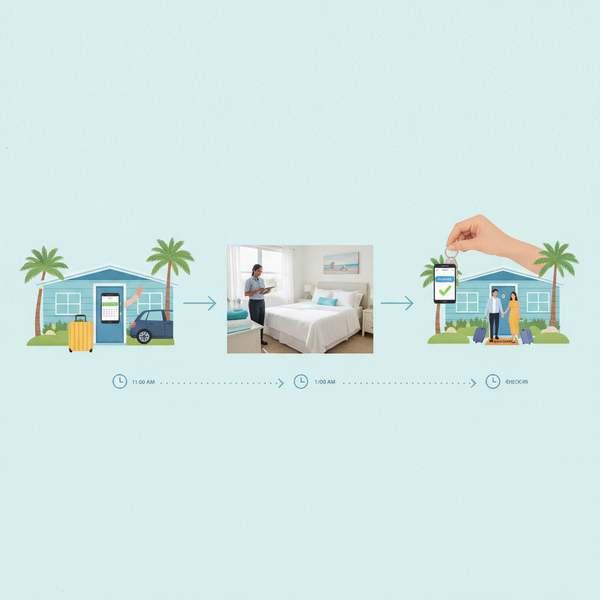
Every checkout→check‑in gap becomes a turn ticket that must traverse three verified states.
Confirmed → Started → Done‑with‑photos (hard cutoff: check‑in − 2 hours)
- Confirmed: vendor explicitly accepts the job; acknowledgment logged.
- Started: on‑site photo of open door or cleaning cart drop‑pin.
- Done‑with‑photos: visual proof uploaded before cutoff.
Photo‑checklist (required set for done‑with‑photos):
kitchen · bathrooms · bedrooms · floors · linens · trash
If 2 hours before arrival the ticket isn’t in Done‑with‑photos, it turns yellow in the dashboard’s “turns at risk today” view.
Every manager and guest‑services lead sees the same list: live, sortable, screaming for action.
4. The escalation: never let the guest discover it
At the cutoff, software isn’t emotional; it escalates.
| Trigger | Who’s Notified | Options (in order) |
|---|---|---|
| No done‑with‑photos by check‑in − 2 h | Regional lead + Guest‑services lead | (a) Rush the assigned vendor → (b) Dispatch backup staff clean → (c) Message guest proactively (before arrival) |
The moment you automate this path, “surprise dirty units” collapse.
A regional lead spends ten minutes juggling rushes instead of two hours handling refunds.
And guest‑relations finally gets time to message before the door opens: “We’re finishing a quality check; arrival at 5 p.m. is guaranteed immaculate.”
That line costs zero stars.
5. Accountability: score vendors, don’t churn by gut
Once every turn ticket has timestamps and states, you can grade vendors by math, not memory.
| Metric | Definition |
|---|---|
| On‑time % | % of assignments reaching done‑with‑photos before cutoff |
| Miss count | Jobs needing backup or guest comp |
| Redo rate | % of cleans re‑opened for quality issue |
| Dispute count | Times vendor challenges a score |
Pay bonuses and retention on those numbers.
Over a quarter, the operator studied cut total vendor churn from 38 % to 17 %.
Instead of rage‑switching vendors after bad weekends, they coached the lowest quartile with data and incentive.
(This will feed a deeper Breezy Keys piece on building a vendor‑scorecard / AP discipline before a crisis.)
6. Cancelled‑clean rule: not a notification problem
Every system dies when people treat cancellations as FYIs.
A cancelled clean must trigger human acknowledgment + immediate re‑assignment.
Automate the check: if cancelled exists without a new Confirmed within 30 minutes, alert every lead. Treat it like a smoke alarm, not an email.
Those 30 minutes decide whether you’re doing a backup clean at noon or refunding at 6 p.m.
✅ Key takeaways
- Make “is this unit guest‑ready?” a verified fact before arrival, discovered early enough to act.
- A done‑with‑photos cutoff plus auto‑escalation converts silent failures into catchable ones.
- Score vendors on misses, redos, and on‑time rate so retention stays data‑driven and consistent.
🧰 Get the tools to fix this before your next turnover
You don't need another meeting to solve cleaning chaos. You need structure: a confirmation step with a hard cutoff, photo proof on every turn, and an escalation that fires before the guest arrives.
That is the system we run across the portfolios we cohost, and it is what Turnwrk, our turnover software, was built to enforce.
If you want it running on your turns, email us at hello@breezykeys.com and we will walk you through how we would set it up on your properties. Prefer a form? breezykeys.com/partners reaches the same inbox.
By the next guest check‑in, you’ll stop learning about a missed clean from the guest themselves.